
Frequently asked questions - Debates

You begin right here! Look through all of the sections in this students’ guide and watch our training DVD (available from your teacher). If your teacher does not have a copy, please email Lucy or Evanna at debates@concern.net and we will post you a copy of the DVD. Make sure to log on regularly to the debates homepage. This is where all the action takes place; motions, pairings, research links and dates appear here first.

Join our blog

Let us know what you think! Join the debate on our blog by commenting on our posts or by joining us as a guest blogger. To become a guest blogger, email us your opinions on motions, debates stories or anything else you can think of that is in any way debates-related. The piece should be 200-500 words. If you send us in a photo to go with it, that would be even better!

Get your team in place

Each team should consist of four speakers, plus as many substitutes. Each team should also have researchers, a timekeeper and as many other “groupies” as you can find. (Everyone that participates in the debates or assists your team will receive a certificate.) Another important thing to do is to select your team captain. Your captain will have the job of defining how your team interprets the motion and of introducing briefly the other members of the team and their arguments. Your captain also sums up your team’s arguments, and refutes the arguments of your opponents at the end of the debate.

Once you receive your motion, the whole team should get together and discuss it, especially your “side” of the motion. Teams proposing the motion must defend the motion; those opposing the motion must argue against the motion.

Plan your approach

During this discussion you should plan your approach. Will you use a team line? i.e. will your captain be the “Taoiseach”, with the rest of the team acting as “cabinet members”? Each of your points/arguments will arise from your ministerial position.

The Concern Debates, as the name suggests, is a debating competition which is open to senior cycle students (4th year to 6th). The debates are an excellent opportunity to learn about the way the world works, and to develop lifelong skills in research and public speaking, all while having fun.

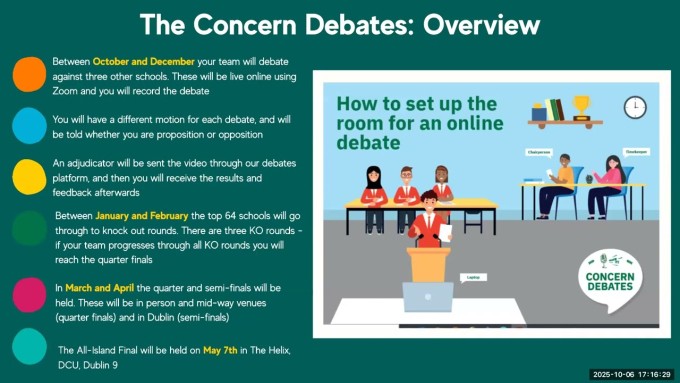
You will have the chance to have your say and argue motions on development issues against teams from other schools. Your team will participate in four debates in the League Phase between October and January. Then, if you are one of the top 32 teams in the country you will progress to the Knockout Phase which runs from February to May.

This is what a few of our past debaters have to say about the debates:
 
“I have found the Concern Debates absolutely brilliant! I have only been in two so far but it has been such a learning experience. I have not only educated myself in subjects like the UN, but I have really gained so much confidence, although the ole' legs shake still when I get up to speak! Thanks once again for this opportunity.”
Sarah Murphy
 
“Due to the debates, I have become much more aware; I buy fair trade products and encourage others to do the same.”
Francis Dowling
 
“Since being involved with these debates I have learned so much. Now especially, I am always encouraging my friends to buy fair trade stuff.”
Kate O’Connor
 
“The debates have helped my confidence and it has made me more aware of issues in the world today.”
Emma Fogarty
 
“The debates make me more conscious of the planet and its people and the fact that I’m a ‘child of the universe.’”
James Mahon
 
“I have much more confidence. I’m more comfortable with GM foods and more open to the views of others.”
Danielle Cuffe

There are many different ways you can conduct your research. For instance, school surveys are great to get some local or firsthand statistics on how your fellow students feel about some of the issues. Do they care about child labour? Do they think corruption in politics is just part of doing business? You could also try to interview people who may have relevant information, such as members of NGOs and embassies, teachers that may have travelled overseas or perhaps someone from your local community.
 
Valuable sources
 
Documentaries and news can contain some really strong information and statistics. They can also provide useful case studies. All of which can be found in abundance on the internet. So, too can podcasts, informative videos and other multimedia. Offline, books and magazines can also be a great source of statistics and quotations relevant to motions (your school textbooks may even come in handy).

Before you begin writing your speech you should take the following points into consideration:

Each speaker has four minutes and 30 seconds to speak (including the captains’ summation). Make sure you speak for no less than four minutes (or you will look like you didn’t prepare well) and for no more than four minutes and 30 seconds (or you will lose some of your hard earned marks).

Don’t try to cram too much information into your speech. Adjudicators prefer to hear three to four well-developed points, with clear information about each of the points. Find some good solid facts to strengthen your arguments, and make sure to quote your source during your speech to back up your point. Look at the marking sheet before you debate so you know what the adjudicators are looking for. Ensure that your points “flow nicely together”. Points are awarded for clarity and logical thought.

Preparation

Prepare your cue cards for the podium. Do not write your entire speech on them. Put key points, facts and quotes on them, and use them to guide you on to your next point.
Practise, practise, practise! In front of the mirror; using a video camera; in front of your class or parents. The more comfortable and convinced you are of the points you are making, the easier it will be to convince others – especially the adjudicators.

Leave time for refutation and rebuttal. When doing your research, try to predict what the other team will say and keep some statistics that could be used to counteract their arguments. Finally, remember to use your wit! Humour really livens up a debate.

This is the essence of debating, the difference between public speaking and debating! Put simply, to refute an argument is to produce evidence (facts or figures) to prove it untrue. To rebut an argument is to discredit it by offering a completely different point of view.

To “do” refutation and rebuttal well, when preparing and researching your own speech you will need to anticipate the kinds of arguments your opponents will use. Jot down notes, quotes and statistics so that you are prepared to call into question the arguments put forward by the other team.

It is essential that every speaker attempts to “have a go” at their opponent’s arguments; each of you can earn 10 marks for refutation and rebuttal. Don’t leave it up to the others on your team. Remember it’s your chance to have your two cents and convince the adjudicators how absurd your opponent’s arguments are. Also, try not to tack your rebuttal onto the beginning or the end of your speech. Try to weave it into the body of your speech and time it well to emphasise the points you are making.

You can put up posters to encourage your friends and family to support your team (even if you are nervous, familiar faces in the audience will help boost your confidence). Remember that the other team will have support too.

You could advertise around your local area or town – is there a local newspaper or radio station who would be interested? Don’t forget to tell your family and friends to come along and support you!

Please ensure that as you face the audience from the podium that the proposing team is on the right and the opposing team is on the left.

Host teams are responsible for providing the Chairperson and Timekeeper. Check with your teacher that you have a chairperson and timekeeper assigned to the task. After the debate it is always nice to have a cup of tea and a chat. It has become a tradition of the Concern Debates for host schools to provide a cuppa and a few bickies after a debate.

Your arguments have been researched and prepared, you know what your team mates are going to say and you’ve got your points ready to refute the other team. The posters are up around the school advertising the debate, the audience is gathered and the Chairperson calls the house to order... you’re off!
 
The team captains will speak twice once to open the debate on behalf of your team and at the end to close your team’s arguments. Throughout the debate you and your entire team should be listening out for points to refute and rebut the other team’s arguments. Write clearly and pass them on to the next speaker or the captain for his/her summation.

  • When you are speaking remember:
  • Use your notes as little as possible
  • Pace yourself ; do not speak too fast; the adjudicators won’t be able to follow your speech and you will waste all of your hard work
  • Be confident, enjoy yourself and be passionate about the subject (even if you are shaking like a leaf). Keep your voice clear and remember you know more about the subject than your audience
  • Quote sources for your statistics and facts
  • Try to refute your opponents arguments
  • If you have a team line, use it sparingly and to emphasise your points (you don’t want your audience or adjudicators to become bored with it)

The open forum takes place at the conclusion of the “formal” debate while the adjudicators are deciding on the winner. This is one of the best parts of the debates evening; it gives you the opportunity to give your real opinions of the motion and to display (or show off) the knowledge of the subject you have gained through research.

The open forum usually lasts 15-20 minutes. The discussion will be facilitated by the Chairperson who will direct the questions asked by the audience to either team. There are no marks given for the open forum, although it is often recommended that there should be!

There are three adjudicators at each debate, one chief and two assistants. They mark students according to the Concern Debates marking sheet. After the open forum session, the Chief Adjudicator will give some feedback on the debate, going over various parts of the marking sheet and offering advice for future debates. He/she will then announce that the motion has been carried (won by the proposition) or defeated (won by the opposition).

Points are awarded as follows:

  • 3 points for a unanimous win (all 3 adjudicators agreed)
  • 2 points for a majority win (just 2 agreed)
  • 1.5 points each for a draw (both teams were equally as good)
  • 1 point for a majority loss (if you lose by a majority)


Keep in touch with Concern!

Use this site to send us your photos, speeches, favourite quotes, opinions of motions, recommended sites etc. We will use this information either on the website, on our blog or in our debates newsletter.

page colours:
  • Black/White
  • White/Black
  • Yellow/Blue
  • Standard

Current Style: Standard

text size:
  • Increase
  • Normal
  • Decrease

Current Size: 100%

Subscribe: Subscribe via RSS Follow us on Twitter Follow us on Facebook Concern Youtube Follow us with email alerts