


Read our 2025 annual report

Knowledge Hub


In Sierra Leone, Issa K. Conteh from Mathoranka Village tells us how a Concern project has revitalised his community.
Never underestimate the impact that your donations are making to the lives of people living in vulnerable communities across the world.
If one man's story encapsulates the impact that your donation can make, it's Issa K Conteh.
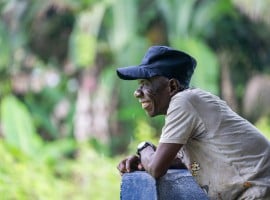
Issa is a 27-year-old husband and father from Mathoranka Village in Sierra Leone, and he works as a teacher in his local secondary school and as a farmer.
A busy man, Issa focuses not only on helping his own family - along with his wife Agnes - but also his wider community, which is one of 108 in north-west Sierra Leone where the Yoti Yoti project aims to strengthen food systems and enable people like Issa to save money and grow their businesses.
“It is a rural community, so after I finish school, I work on the farm," Issa tells us. "I grow rice, groundnuts, potatoes and cassava. I sell some; I consume some. I use that money to take care of my family."
"This was a vulnerable community"
Mathoranka Village is hard to reach, the road network in the area is poor and most people have limited access to transport.
As with many vulnerable communities across the world, meaningful change begins with donations from individuals and institutions alike, donations which allow people like Issa to take control of their own destiny and start to put money aside for their families' futures.
In the past, Issa struggled to support his family but the Yoti Yoti project has played a big role in giving him options that he never had before.

“A couple of years ago, we heard about Concern," he says.
"When Concern wanted to come work here, they did some research. We heard that they wanted to work with the most vulnerable communities. I'm part of the business group (the Village Savings and Loans Association, or VSLA), the nutrition group, and the agriculture group too.
“I didn't used to save because what I got at the end of the day was not enough. But for now, I've started to save because of the intervention of this Yoti Yoti project.
“The VSLA taught us business skills. There are 30 members in our group and there are three groups within our community. In the past, when people were doing business, you would see it start to fail after two or three weeks. But now we have gained knowledge on how to do business and we are seeing those businesses improve.”
"There was no peace within the family - now there is peace"
Another aspect of Concern's work in communities like Mathoranka Village relates to family dynamics, and improving relationships between men and women in vulnerable contexts.
Issa and Agnes are participants in Living Peace, part of the Yoti Yoti project, which is an initiative that was founded on the belief that social change begins within the family.
Living peace recognises that harmful gender norms, unequal power relations, and unresolved trauma within households are key drivers of conflict and addressing these dynamics at home is essential for building safer and more peaceful communities.
“(In Living Peace) we learned how to solve conflict," Issa says.
"For the past years, there were a lot of misunderstandings and a lot of conflict within the family.
"In our culture, we don't usually involve women in decision-making, but through Living Peace, we learned that whenever we want to make decision, we involve each and every one of the family. We involve the children, the women. So they give their own contribution, too. Before we had some families that were almost about to divorce but from the intervention of Living Peace, they are now working together."
“I learned how to solve conflict. I can advise that it is not good for you to embarrass your wife.
"Whenever you want to make a decision or you want to take any action, you need to involve her. This inclusion is very important. Everyone in the family is very important. So it's good for you to seek consent or advice from your wife or from your children whenever you want to make a decision.”
"I want a better future for my children."
The work Concern does with the support of our donors to bring families together and reduce tension in the household extends far beyond Sierra Leone.
The Resilience Programme in Somaliland, for instance, looks to support families whose everyday lives are punctured by conflict, stress and even violence.
Mowlid is a 50-year-old father of nine from Laco in Somaliland, who spoke to us about how the programme changed the dynamic between him and his wife Fardowsa and broke a "generational curse" that threatens families in vulnerable contexts.
"I used to come home angry and exhausted," he tells us.
"I would start yelling at my wife - why did you spill the milk? Why did the animal eat this? Why are the kids outside like that? Where were you? Everything became a conflict. That was the environment we grew up in - shouting, blame, and stress - so we thought that was normal."

The Resilience Programme has had a profound effect on Mowlid's life at home, however, and he is now dreaming of big things for himself, for Fardowsa and for their children.
“Our minds opened, and we felt at ease,” he says of the programme.
"For the first time, we saw that the way we were raising our children was not healthy - not for them and not for us. Even God is not proud of how we were raising our children.
"We realised we were passing down the same chaos we grew up in. The weekly sessions used simple methods like family photos showing two different households - one arguing, the other cooperating.
“We used to resonate with the bad parents in the photos. But week after week, as we learned, we slowly became like the good families shown on the posters. It made me understand something important: 'The actions that children see from their parents is what they will take to their own household.'"
Mowlid now hopes to go on and work with families who have experienced the same difficulties that he has.
"I want a better future for my children. I want them to be doctors and engineers, not farmers.
"I (also) want to make it out of this tiny village. I want to be successful for my family. Maybe even become a tutor for family issues.”
“Thank you, Concern. I wish you could stay longer in our village, to help those who still don’t believe. This programme didn’t just change my family - it broke a generational curse.”
To all of our donors, a heartfelt thank you. Your support continues to make a huge difference to the lives of people like Issa, Mowlid and many, many thousands more like them.
Keep up to date with how your donation is making an impact by following us on WhatsApp.
Our impact in 2025

people reached through our emergency response

people reached through our health interventions

people reached through our livelihoods programmes