


Read our 2025 annual report

Knowledge Hub

 Flagship Programme
BRAVE
Context
Pakistan is among the countries most exposed to the impacts of climate change, despite contributing less than 1% of global greenhouse gas emissions. Increasingly frequent floods, droughts, heatwaves, glacial lake outbursts and other climate-related hazards are putting lives, livelihoods and essential services at risk, particularly for people already living in poverty.
Pakistan’s diverse geography, from high mountain ranges and the Indus Valley plains to coastal, desert and agricultural areas means communities face very different climate risks. With a population of around 225 million people, and more than one-third living below the poverty line, these hazards can quickly deepen existing social and economic vulnerabilities.
The 2022 floods showed the scale of this challenge, affecting more than 33 million people across the country, damaging agricultural land and infrastructure, and displacing millions. In the 5 BRAVE target districts, households surveyed reported extensive damage to agricultural land, standing crops, fruit orchards and irrigation systems. Further flash floods and cloudbursts in 2025 caused significant damage in parts of Khyber Pakhtunkhwa and Gilgit-Baltistan, underlining the need for locally led climate adaptation and preparedness.
Concern Worldwide Pakistan is implementing Building Resilience and Addressing Vulnerability to Emergencies (BRAVE), funded by the Foreign, Commonwealth and Development Office (FCDO), from January 2023 to July 2028. The programme combines long-term resilience building with humanitarian assistance, helping at-risk communities prepare for, respond to and recover from climate-related disasters.

Programme Overview
BRAVE is led by Concern Worldwide in partnership with the Aga Khan Foundation, CESVI, Welthungerhilfe and Muslim Hands, with technical support from HelpAge International, the Asian Disaster Preparedness Centre and ODI Global.
The programme works closely with government authorities and national non-governmental organisations to ensure that climate adaptation planning is locally owned, inclusive and aligned with public systems.
The climate resilience component aims to strengthen the ability of at-risk communities, particularly women, older people and people with disabilities, to anticipate, adapt to and absorb climate-related shocks and stresses.
This is supported through 7 linked areas of action:
- 1
1.
Developing climate adaptation plans at village, union council and district levels.
- 2
2.
Supporting communities and institutions to implement and manage these plans.
- 3
3.
Helping at-risk households access more diverse and climate-resilient livelihood opportunities.
- 4
4.
Leveraging public and private sector resources for climate adaptation and mitigation actions.
- 5
5.
Establishing business and knowledge hubs to support resilience, learning and market linkages.
- 6
6.
Strengthening the capacity of government departments to integrate climate adaptation into planning and services.
- 7
7.
Providing humanitarian relief and recovery support to protect lives, dignity and livelihoods after disasters.

BRAVE uses conflict-sensitive, inclusive and accountable approaches throughout its design and implementation. This includes applying ‘Do No Harm’ principles, integrating quality and accountability standards, and promoting women’s meaningful participation. The programme’s ‘Engage with Men’ approach works with men as to support gender equality and help create safe, locally appropriate spaces for women’s voices in community decision-making.

Partnerships
Partnership is central to BRAVE’s approach. At community level, the programme supports village and union council climate adaptation forums, which help gather local climate risk data and guide adaptation planning.
At district level, the consortium works with government line departments, knowledge hubs and business hubs to connect community priorities with technical expertise, public planning and private sector opportunities.
BRAVE also coordinates with provincial and national institutions, including Planning and Development departments, Provincial Disaster Management Authorities, the Pakistan Meteorological Department and the National Disaster Management Authority.

Outcomes
BRAVE’s overall intended impact is that extremely poor and vulnerable people in Pakistan are more resilient to climate-induced risks, shocks and stresses.
The programme works towards two connected outcomes:
- Empowering communities to anticipate, adapt to and absorb the impacts of climate hazards.
- Supporting effective humanitarian relief and recovery responses that reduce suffering, protect livelihoods and safeguard long-term resilience investments.

Programme Activities
BRAVE is delivered through 4 main programme outputs, each designed to strengthen climate resilience at household, community and institutional levels.
Output 1: Inclusive climate adaptation forums develop and implement climate action plans.
BRAVE supports community risk assessments, climate adaptation planning, disaster risk reduction and raising awareness so that communities are better able to prepare for and respond to climate-related hazards.
Output 2: Climate-vulnerable households adopt more resilient and diversified livelihoods.
The programme promotes improved agricultural practices, sustainable natural resource management and climate-smart technologies to help households reduce their exposure to climate-sensitive livelihoods.
Output 3: Climate-sensitive private sector pathways create financing and job opportunities.
BRAVE supports off-farm livelihood options, market linkages and income diversification, helping vulnerable households build more stable sources of income.
Output 4: Public sector systems generate and use climate knowledge. The programme works with government actors and technical partners to strengthen climate knowledge, promote risk-sensitive practices and support risk financing approaches.
Across all outputs, BRAVE promotes the participation of women, young people, older people, people with disabilities and other marginalised groups, so that climate resilience strategies reflect diverse community priorities and strengthen social cohesion.

Emerging Lessons
Emerging learning from BRAVE highlights the importance of combining anticipatory, adaptive and absorptive capacities. This means supporting communities not only to respond to shocks when they happen, but also to plan, adapt livelihoods and systems, and protect gains made through long-term resilience work.
- Inclusive climate adaptation forums can strengthen local ownership of climate action. BRAVE has supported 419 village and union council forums, helping marginalised groups move from being recipients of assistance to active participants in resilience planning.
- Linking community-led climate action plans with district development planning helps make resilience gains more sustainable and increases the likelihood that local priorities are reflected in formal government systems.
- Women’s participation is strengthened when leadership training is combined with efforts to engage men as allies. This approach can help address social barriers and create safer, more supportive spaces for women’s involvement in community decision-making.
- Contextually appropriate climate-smart technologies, such as certified climate-resilient seeds and improved storage, can deliver practical benefits for households, including improved productivity and food security.
- Knowledge hubs can connect community priorities with research, technical expertise and government planning, helping ensure that resilience strategies are evidence-informed and grounded in local realities.
- Access to savings, micro-credit and other financial services can help vulnerable households cope with shocks without selling productive assets, while also supporting investment in more resilient livelihoods.
- Smallholder farmers can benefit from stronger links to certified value chains and wider markets, which may improve returns and reduce reliance on local intermediaries.
- Vocational training, including digital freelancing, needs to be accompanied by access to the right tools, reliable connectivity and energy solutions, particularly in remote areas.
- Livelihood planning should look beyond village-level demand and build stronger links between rural producers, artisans and wider urban or international markets to avoid local market saturation.

Additional Resources

Testimonials
Testing climate-resilient maize in Ghize
In the target districts of Ghizer and Astore, maize is important for household food security and livestock feed, especially during winter. However, production is limited by rugged terrain, harsh weather and local maize varieties that are well adapted but produce relatively low yields.
Through BRAVE programme, improved, climate-resilient maize varieties were introduced; White Pearl and SG2002 (Afgoi), sourced from the Punjab Seed Corporation. Through Farmer Field Schools, farmers tested the new varieties against traditional maize while learning improved agronomic practices.
Mr Kareem, a farmer from Ghizer, tested the new and traditional varieties side by side, cultivating each on one kanal of land and preparing the soil with farmyard manure and Bokashi, an organic fertiliser. The comparison showed promising results. The improved maize plants grew almost twice as tall as the traditional variety and produced up to 5 cobs per plant, compared with around 2 cobs on the local variety. Farmers also observed that the cobs were approximately double the size.
Local agriculture department estimates suggest that the improved variety could produce up to 3 times the yield of the local variety. Other Farmer Field School participants reported similar increases in grain and fodder production. To support future use, Mr Kareem received hermetic drums and bags to protect the improved seed from moisture, pests and mould.
The trial has generated interest among other farmers, several of whom want to purchase seed for the next planting season. BRAVE will conduct a cost-benefit analysis after harvest and explore scaling through private sector partnerships and the business hub.
The experience shows that climate-smart agricultural technologies are more likely to be adopted when farmers can test them directly, compare results with existing practices and access the storage and market support needed to continue using them.
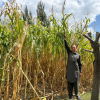
I plan to retain my seeds for the next season and sell surplus seeds to other farmers. This will support local seed multiplication.
From crisis to confidence: Benazir’s journey of resilience in Upper Chitral
In Upper Chitral, Benazir, a mother of three, was already facing significant economic pressure. Her husband worked as a seasonal labourer for only part of the year, leaving the household with limited and irregular income. In 2024, floods damaged large parts of the family home, including two rooms, the kitchen and the boundary wall, leaving them without safe shelter and with very limited means to recover.
Through the BRAVE humanitarian response, implemented by AKRSP, Benazir received immediate relief and support for early recovery. This included a tent for temporary shelter, a debris removal kit to help clean and reclaim the damaged property, and a cash-for-goods grant of PKR 28,000 to meet urgent household needs.
As part of BRAVE’s recovery-oriented support, she also received a micro-enterprise development grant of PKR 60,000 and practical business training. The training covered areas such as inventory management, pricing and customer service, helping her take the first steps towards establishing a small home-based business.
Benazir used the grant to start selling women’s shoes, garments and cosmetics to neighbours and nearby households. The business now provides an income of around PKR 15,000 per month, which she uses to support household needs and her children’s education. The support has helped her move from reliance on emergency assistance towards a more stable source of income and a stronger role in her community.
Benazir’s experience shows how combining immediate humanitarian assistance with livelihoods support can help disaster-affected households protect dignity, restore income and begin rebuilding resilience after climate-related shocks.
“Today, I am no longer waiting for someone’s help I am building my life on my own."
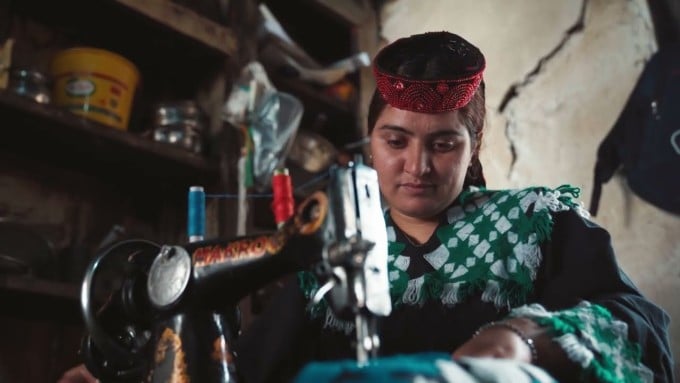
 BRAVE Women
Organisations who fund us
Partner Orgnanisations
CEVSI
Aga Khan Foundation

HelpAge International
Welthungerhilfe
Overseas Development Institute

ADPC

CEVSI
1/6
 Flagship Programmes
 Evaluation
 Knowledge Matters Magazine