


Read our 2025 annual report

Knowledge Hub


Led by Concern and funded by Irish Aid, this community-driven, cross-border initiative is fighting child hunger and malnutrition in the Mandera Triangle – a region where Ethiopia, Kenya, and Somalia meet.
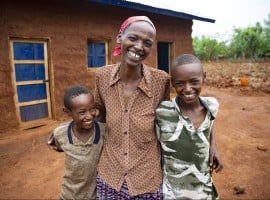
For Binta Feriahmed, every drop of water used in her village in Ethiopia’s Afder Zone came at a steep cost.
“I used to stand at home, confused and thinking: How much should I use to wash clothes? How much for cooking or bathing? How much for drinking?” the 35-year-old mother of eight recalls. “It was never enough.”
The rationing was the result of a dangerous three-hour round trip to the community’s only water source, the Ganale River. Women made the trek while heavily pregnant, carrying toddlers alongside heavy jerrycans. Some mothers miscarried from the physical strain; others lost children to crocodiles in the waters. Many had to make the journey twice a day, because the 20 litres they could carry home wasn’t enough for the day’s needs.
For all of that effort, even the water carried hidden risks. “It was dirty, and made our children sick with diarrhoea and vomiting,” Binta adds.
On the frontlines of the global hunger crisis
It’s a similar story for hundreds of communities across the Mandera Triangle, the region where Ethiopia, Kenya, and Somalia meet. In a part of the world known for recurring droughts, the Triangle is hit especially hard. Families rely heavily on livestock and agriculture to survive, but finding viable land for grazing and farming has become increasingly difficult. Communities are trapped in a cycle of failed rains, conflict, low economic growth, food insecurity, and a severe lack of healthcare and water infrastructure.


As a result, hunger is a chronic emergency. At the height of the 2020-2023 drought in the Horn of Africa, global acute malnutrition rates surpassed 35%, more than double the World Health Organisation’s emergency threshold. In 2023, wasting (the most life-threatening form of malnutrition) affected over 1.63 million children in Ethiopia, 945,000 in Kenya, and 500,000 in Somalia.
But treating malnutrition is just one piece of the puzzle. Children who recover often relapse if the conditions that made them sick don’t change. Fully ending hunger means we have to stop treating only the symptoms – and start systematically addressing the root causes. In Mandera, those roots are tangled.
Evolving the approach: Why we launched Hanaano
Concern has worked in the Horn of Africa for over five decades, beginning with Ethiopia in 1973 before expanding into Somalia and Kenya.
Since the beginning, our focus here has been fighting child malnutrition by both treating the cases and tackling the root causes. But the climate crisis and increasingly protracted conflicts in the region changed the maths. Facing a new era of natural disasters, violence, and mass displacement, we knew we had to evolve our approach. With decades of earned trust and proven progress, we also knew we could make that shift a reality.
In 2023, backed by a €15 million investment from Irish Aid, Concern launched Hanaano. Translated as “to nurture” in Somali (a language spoken throughout the Triangle), Hanaano began as a three-year initiative designed to reduce and prevent child wasting by simultaneously addressing its root causes.
Attacking the root causes of hunger
Operating across 105 communities, Hanaano weaves together nutrition, livelihoods, water, sanitation, and hygiene (WASH), natural resource management, social and behavioural change, gender equality, and conflict sensitivity into a single safety net.
That’s a massive logistical undertaking, but these activities work together to support three key outcomes:
- Better nutrition at home: Improving feeding and caring practices for infants, young children, adolescents, and women of reproductive age. (Nutrition, WASH, and support for women and girls)
- Stronger livelihoods: Improving food security and supporting profitable and climate-resilient work. (Natural resource management, economic activities, food production, and crisis modifiers to account for emergencies)
- Evidence that drives change: Gathering data and evidence of what works to help inform national and regional strategies to prevent child wasting. (Community-level learning)
Taken together, these outcomes help ensure that families can reliably access nutritious food while simultaneously lowering the risk of preventable diseases that often trigger malnutrition.


“We fetch water without limits”: Building a community-led response
One of the key aspects of Hanaano is that its 300,000 participants are active agents in changing their lives. Rather than going in with a set list of activities, we know that communities are often best suited to identify the challenges they face and the solutions that will be most sustainable for them.
That’s how the issue of water-gathering came up in our early meetings with Binta’s village. The women made their priority clear: They were raising young children with chronic malnutrition and diarrhoea. Many of them went through their own pregnancies malnourished.
A water tap wouldn’t change everything, but it would nevertheless be a life-changer.


“We fetch water without limits,” Binta says of the impact the new tap made. “If my husband is home, he goes. If I’m free, I go.”
More importantly, many of her family’s physical and mental health issues went away: “My children are clean, healthy, and happy,” Binta says. “They are no longer getting sick from diarrhoea, and I’m no longer too tired from walking hours to fetch water.”
Creating new safety nets and local leaders
Across the Mandera Triangle, Hanaano participants have stepped into leadership roles and community support systems through Village Savings and Loans Associations (VSLAs), women-led farmer groups, Mother-to-Mother and Father-to-Father support groups, and natural resource management committees.
As part of the programme, each community also develops its own nutrition action plan, setting priorities like clean water access, home garden cultivation, and market access. They then elect representatives who bring those plans directly to local government bodies to foster local support.
While building long-term systems to support nutrition, agriculture, and governance, Hanaano is also designed to deliver immediate assistance in an area where conflict, natural disasters, and other emergencies can lead to acute need. Pre-arranged contingency funds called Crisis Modifiers have allowed Hanaano teams and communities to respond quickly.
When cuts to global humanitarian aid in 2025 led to significant disruptions in services across the Triangle, Hanaano’s Crisis Modifier allowed communities to allocate funding to address obstacles as they emerged, coordinating last-mile transport of therapeutic food, restoring treatment for malnutrition that had been interrupted due to the abrupt budget cuts, and replenishing supplies following stock shortages.


From survival to self-reliance
From the shores of the Ganale River in Binta’s village, you can see the neighbouring Liben Zone. There, in the small village of Kilimisingo Kebele, Shinda Abdulahi prepares food with her Mother-to-Mother group, using the vegetables she’s grown in her local agriculture group.
Shinda, a 33-year-old mother of six, joined both groups through Hanaano. Equipped with seeds, tools, and training, her group now harvests tomatoes, cabbages, chilis, and more. The cooking demonstrations via her Mother-to-Mother group have helped her send her children to school each day with the nutrients they need.
But the greatest aspect of the programme for Shinda is being part of a group of women who lift each other up. “We talk openly about the problems we face and encourage one another to keep going,” she says.


Nearby in Liben is Habiba Subo, a 28-year-old mother of nine who found the resources she needed to build a better life for her family through Deyah, a Hanaano-supported VSLA. The group’s 45 members contribute 500 Ethiopian birr (about €2.75). Their combined funds cover the rent for a workspace and help build their savings.
Most importantly, Habiba – a skilled seamstress – received a sewing machine and small business management training. She taught her husband, Ali Mohamed, to sew, and they now work as tailors, creating two income streams where they only had one before. She buys affordable and fresh vegetables from her local Mother-to-Mother group, also established through Hanaano.
“I am someone who can have what I need,” she says proudly. “My life has changed completely.”
Breaking the cycle: “The life we are in now is light”
Many of Hanaano’s participants across all three countries speak of the programme in terms of complete change. Ultimately, the programme is about breaking generational cycles of risk.
“The life we were in before was darkness. The life we are in now is light. They are two different lives,” says Deka Aden Hussein, a resident of Kenya’s Mandera North constituency.
Deka has seen a massive shift in how women in her village access healthcare. “A pregnant mother encourages another mother [to go], asking, ‘Have you gone to the hospital?’” Indeed, antenatal care has also become routine for many families in Mandera North, ensuring children enter the world with a greater chance of survival.
This is especially personal for Deka, a 34-year-old who has tragically lost four children. Her first child died after a prolonged home birth, and she believes that if she had given birth at the hospital he would be alive today.
Her last birth happened during Hanaano, with two healthy twins delivered in the hospital via caesarean section. “They saved me and my children.”


“I don’t see us ever sliding backwards”
“Before, we were just people who stayed at home, who had no jobs, just mothers staying in their houses,” adds Halima Adan Falir, a fellow Mandera resident in Kenya.
Through Hanaano, Halima was selected to participate in a stove-making workshop. Fuel-efficient stoves serve a dual-purpose: Learning to make them gives people a vocational skill that they can turn into a livelihood, and using them at home reduces fuel consumption and the health risks that come from indoor wood-burning stoves.
“Firewood that used to last for just one month now lasts us for three months,” she says.


Halima and her group initially sold 350 stoves to the Hanaano programme, which were then given to the most vulnerable members of the Mother-to-Mother groups across three subcounties in Mandera. This earned the group 470,000 Kenyan shillings (roughly €3,250).
“We felt pure happiness,” Halima says of the payday. The members took some of it as a salary, and invested the rest into establishing a VSLA and purchasing materials to make more stoves.
“I don’t see us ever sliding backwards.”
Help us do more where the need is greatest
Learn more about the Hanaano programme.


