Highlights of Concern Worldwide's historyHighlights of Concern Worldwide's historyHighlights of Concern Worldwide's history

Timeline: A history of Concern Worldwide

Timeline: A history of Concern Worldwide
Story21 January 2026

Over the last six decades, Concern has been on the frontlines of some of the world's biggest crises — and some of the most transformative approaches to ending poverty.

In 1968, a small group of people in Ireland launched a major aid operation in response to famine and conflict in Biafra, because they couldn’t continue to sit by and watch it play out. 

More than half a century later, Concern still works under the same principle, doing whatever we can and whatever it takes to help millions of families break the cycle of poverty each year. Here’s a closer look at our last six decades of work. 

1967-68: Beginnings in Biafra

“Concern is an organisation born of famine, in response to famine.”

Fr. Aengus Finucane - Early Concern volunteer and former CEO

Concern Worldwide begins as Africa Concern in the living room of John and Kay O’Loughlin-Kennedy, an ordinary couple who were watching the horrors of conflict play out in Nigeria’s breakaway province of Biafra on the evening news. John’s brother, Father Raymond Kennedy, had also been in Biafra and brings back news of a developing famine — a catastrophe still fresh in Irish historical memory. 

Read more
A feeding center north of Owerri in Biafra. Photo: Peter Williams
L-R George Cockin, Anglican Bishop of Owerri, John O'Loughlin Kennedy, co-founder of Concern, Joseph Whelan C.S.Sp, Catholic Bishop of Owerri at launch of Joint Biafra Appeal June 28 1968
L-R George Cockin, Anglican Bishop of Owerri, John O'Loughlin Kennedy, co-founder of Concern, and Joseph Whelan C.S.Sp, Catholic Bishop of Owerri, at launch of Joint Biafra Appeal, June 28 1968.
The Columcille which departed Dublin to deliver aid to Biafra in September 1968. Photo: Concern Worldwide.

1970-72: New beginnings in Bangladesh

The deadliest tropical cyclone on record, Cyclone Bhola, makes landfall in East Pakistan on November 12, 1970, killing as many as 500,000 people and furthering a hunger crisis amid political instability. 

Africa Concern becomes Concern Worldwide with the launch of the Pakistani Famine Appeal. The first volunteers arrive in Calcutta in 1971 to support displaced Bangladeshis, shortly before the start of a war of independence that will continue for most of the year. 

Read more

The work continues: Support Concern in 2026

1973: Entering Ethiopia

Concern arrives in Ethiopia in the autumn of 1973 as part of a massive mobilisation to prevent famine in the northwestern province of Wollo. Unfortunately, the international warning system is too late to avert disaster. A team led by Father Jack Finucane (Aengus’s brother and a fellow volunteer from Biafra) help to triage a desperate situation that kills 200,000. 

Read more
Kay O'Loughlin-Kennedy (left-hand side in the white dress) and members of the Concern team in Calcutta, 1971.
Frs. Aengus Finucane and Raymond Kennedy in Bangladesh, 1972.
Fr. Jack Finucane discusses the drought in Ethiopia with the country's Chief Commissioner for Relief and Rehabilitation, Ato Shimelis Adugna, 1974
Irwin Shorr supervising Concern's Nutrition Unit in Saidpur, Bangladesh, 1973
Irwin Shorr supervising Concern's Nutrition Unit in Saidpur, Bangladesh, 1973.
Foundational members of Concern Bangladesh: Irwin Shorr, Aengus Finucane, Jack Finucane, Fintan Farrelly, and Patricia Hickey
Foundational members of Concern Bangladesh: Irwin Shorr, Aengus Finucane, Jack Finucane, Fintan Farrelly, and Patricia Hickey.
Mike Doheny and Aengus Finucane at work in Bangladesh, 1973.

1978: Relief, recovery, and rebuilding in Cambodia

A four-year genocide in Cambodia under the Khmer Rouge and Pol Pot begins in 1975, killing between 1.5 and 3 million people over just four years. Millions more are displaced, crossing the border into Thailand. This creates the largest humanitarian crisis of its time and triggers a massive international humanitarian response. 

Read more
Cambodian refugees in Sa Kaeo Refugee Camp, Thailand 1979. Photo: Pierre Tambar/UNHCR
Dominic MacSorley, Aengus Finucane, and Angela O'Neill at the Thai-Cambodia border, 1982.
A young Cambodian girl in Thailand, 1982
A returnee to Cambodia receives a kit with blankets, a mosquito net, and kitchen supplies, 1991. Photo: Concern Worldwide
Repatriation buses entering Cambodia in 1992. Photo: Concern Worldwide

1983-85: Saving lives with Live Aid

Another famine is confirmed in Ethiopia in 1983, this time affecting the provinces of Tigray and Wollo. It’s the worst in over a century; it’s also the first famine to be seen around the world via television broadcasts. Jack Finucane is a key figure in bringing media attention to those most affected by it, and Concern’s lifesaving response, all while managing a team of nearly 950 humanitarians (over 93% of whom are Ethiopian nationals).  

This coverage launches an unprecedented public response. The charity supergroup Band Aid forms in response to this with the charity single “Do They Know It’s Christmas?” released in 1984. Jack works with Band Aid founder Bob Geldof to spread awareness. Part of the $185 million raised by Live Aid, Geldof’s 1985 benefit concert held in London and Philadelphia, is donated to Concern. The funds support over 52,000 people across 26 resettlement sites in Korem, Ethiopia.

Jack Finucane at a feeding centre in Ethiopia, 1984. Photo: Concern Worldwide
Live Aid co-organiser Bob Geldof is interviewed in Ethiopia, 1984.
Live Aid at Philadelphia's JFK Stadium, 1985. Photo: Wikimedia Commons

1984: A continent consumed by civil wars

In the wake of the devastating famine in Ethiopia, Concern Mozambique opens at the height of one of the deadliest civil wars in Africa. Over 1 million people will die from either violence or famine over 15 years between 1977 and 1992. Mozambique is among the first responses Concern launches as more than a dozen countries across the continent fall into civil wars. Many of these conflicts continue for more than a decade. 

Read more

1988-94: A few more countries

Concern expands its fundraising offices, beginning with one in Belfast in 1988. In 1991, Concern Worldwide UK opens in London, followed by Concern Worldwide US in New York in 1994 and Chicago in 1999.

1989: Fear, stigma, and a new “killer disease”

Most data suggests that the spread of HIV and AIDS began in sub-Saharan Africa in the late 1970s, with a rise in cases throughout the 1980s. The continent becomes the hardest-hit in a growing pandemic linked to fear and stigma around a new “killer disease.” 

Read more
Concern Field Director Tom Lavin in southern Sudan, 1988, talking to civilians displaced by conflict waiting at a concern feeding center.
Concern Field Director Tom Lavin in southern Sudan, 1988, talking to civilians displaced by conflict waiting at a Concern feeding centre.
Concern employee Celestine leads a village meeting in Murrupula district, Mozambique, 1995.
Landmine clearance in Angola, 1995.
Concern Sudan's team during the Second Sudanese Civil War (1983-2005).
HIV and AIDS awareness-raising in remote villages in Tanzania.
A Concern technician carries out an HIV test at an antenatal clinic in Rwanda, 2006.

1993: Tragedy in Somalia

Concern launches a response in Somalia in 1992 after famine is confirmed amid drought and conflict. The response team includes 23-year-old Irish nurse Valerie Place, the youngest volunteer at the time and the manager of a therapeutic feeding centre for young children. On February 22, 1993, Place is fatally shot when the humanitarian convoy she was traveling with is ambushed. Aengus Finucane, who is also traveling in the convoy, administers her last rites. 

26 years later, Dr. Du’ale Mohammed Adam is also killed in Somalia during a 2016 explosion. At the time, Dr. Adam — a 33-year-old father of five — is working with Concern to address a growing drought in the country that had been threatening to create another famine. 

Concern nurse Valerie Place at work in Somalia, 1993 Photo: Concern Worldwide

1994: The Rwandan genocide

In less than 100 days, over 800,000 Tutsi and Hutu moderates are murdered, 1 million people are internally displaced, 2 million flee to other countries, and 95,000 children are orphaned. In the wake of the Rwandan genocide, Concern launches its biggest emergency response to date. This includes working over three years to reunite children with family members or foster parents. After the immediate needs are met, Concern remains in the country and works with families to build financial and food security through programmes like Graduation. 

1998-99: Closer to home in Kosovo

The breakup of Yugoslavia leads to a series of ethnic conflicts and wars of independence throughout the Balkans. Among them is a 15-month war in Kosovo that leads to nearly 90% of Kosovar Albanians being displaced, including nearly 1 million forced to neighboring Albania and Macedonia.

While our work normally falls in Asia and Africa, Concern sends an assessment team to Albania on April 4, 1999 and works with both Kosovar refugees and internally-displaced Albanians. We soon move from Albania into Kosovo, providing humanitarian support to communities that sustained some of the worst damage as nearly 1 million displaced Kosovars return home over the span of a month.

Volunteer Noel Molony brings a displaced Rwandan man to a clinic to be treated for cholera. Photo: Liam Burke/Press 22/Concern Worldwide
An emergency food distribution in Rwanda, 1995.
Rwanda Country Director Anne O'Mahony with US Secretary of State Madeleine Albright during her visit to the Runda transition camp in Rwanda.
Concern CEO Dominic MacSorley speaking to Mary Robinson in Rwanda in the wake of the genocide. Photo: Concern Worldwide.
Zenun returns to his home in Peja, Kosovo after three months as a refugee in Montenegro
Zenun returns to his home in Peja, Kosovo after three months as a refugee in Montenegro.
The aftermath of the shelling in Kosovo, 1999. Photo: Concern Worldwide

2000: Revolutionising how we treat malnutrition

Concern and partner Valid International pilot a new model for addressing childhood malnutrition during a famine in Ethiopia’s Hadiya and Wollaita zones. Initially called Community-Based Therapeutic Care (CTC), the programme brings treatment into communities rather than centralised care centres. Rather than feeding children with therapeutic milk at these centres, parents are able to get outpatient treatment through a ready-to-use therapeutic food often known as Plumpy’Nut.

Read more
A nurse examines a malnourished child in Malawi in 2002
Nurse Sr Walsama checks a malnourished child in the Dowa region of Malawi in 2002. Photo: Pieternella Pieterse

2004: The Indian Ocean earthquake and tsunami

On December 26, 2004, a 9.2-magnitude earthquake strikes off the coast of the Indonesian island of Sumatra, creating a tsunami with waves as high as 100 feet. It remains the deadliest natural disaster of the 21st century, killing nearly a quarter of a million people across 14 countries. Concern responds immediately in Indonesia and Sri Lanka, supporting 16,000 families hit hardest by the devastation. 

2007: Graduating from extreme poverty

Originally developed in Bangladesh by the nonprofit BRAC in 2002, the Graduation Model proves to be a success for families sustainably beating poverty while starting their own businesses. It works across four pillars: social protection, livelihood development, financial inclusion, and social empowerment. 

Read more

2009-16: Innovations for mothers and children

In keeping with Concern’s methods of challenging tradition in order to find more effective ways of delivering aid and development support, Concern launches Innovations for Maternal, Newborn and Child Health with funding from the Bill & Melinda Gates Foundation. 

Read more
Idil* turning on the solar light she received as part of the Green graduation programme by Concern. (Photo: Mustafa Saeed/Concern Worldwide)
Idil* turning on the solar light she received as part of the Green Graduation programme by Concern. Photo: Mustafa Saeed/Concern Worldwide
Since Rabeya's employment after vocational training with Concern Bangladesh, her mother, once burdened with housemaid work, can now stay home and look after their family. Photo: Mumit M/Concern Worldwide
Alexia Mukashyaka (40) and her daughter Brigit (2) at her tailoring shop in Mugombwa, Gisagara. Alexia was selected for the Graduation Programme in 2019. After investing in a sewing machine, she started up a successful tailoring business, making on average 20 outfits for women each week. She plans to expand and eventually open a hairdressing salon, and is currently receiving lessons on hair styling. (Photo: Eugene Ikua/Concern Worldwide)
Alexia Mukashyaka (40) and her daughter Brigit (2) at her tailoring shop in Mugombwa, Gisagara. Alexia was selected for the Graduation Programme in 2019. After investing in a sewing machine, she started up a successful tailoring business, making on average 20 outfits for women each week. She plans to expand and eventually open a hairdressing salon, and is currently receiving lessons on hair styling. Photo: Eugene Ikua/Concern Worldwide
Photo: Concern Worldwide.
Callers using Chipatala Cha Pa Foni (Health Centre by Phone) in Malawi dial the shortcode 59090 and are connected directly to health workers. Photo: Sam Strickland
Students from the Concern Makerspace Programme in Nairobi University. Students here work on ways to make medical devices more accessible in the developing world.  Photo: Gavin Douglas / Concern Worldwide
Students from the Concern Makerspace Programme in Nairobi University. Students here work on ways to make medical devices more accessible in the developing world. Photo: Gavin Douglas / Concern Worldwide

2010-15: Earthquakes in Haiti and Nepal

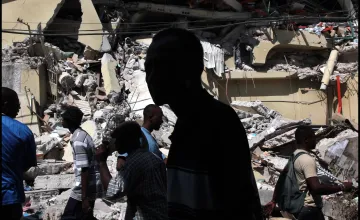
The last decade begins with a 7.0-magnitude earthquake that strikes Haiti on January 12, 2010. Having been in the country for nearly 15 years, Concern springs into action. We roll out one of the largest emergency responses in our history within 48 hours, one that continues through a major cholera outbreak and Hurricane Tomas in the same year, as well as Hurricane Matthew in 2016. 
Read more
Aftermath of the 2010 earthquake in Port-au-Prince, Haiti. (Photo: Concern Worldwide)
Aftermath of the 2010 earthquake in Port-au-Prince, Haiti. Photo: Concern Worldwide
Downtown Port-au-Prince, Haiti, on January 16, 2010. Four days after a 7.0-magnitude earthquake hit the country. Photo: Laurie Richardson/Concern Worldwide
Concern Worldwide US’s Ed Kenney worked with Haitian colleagues like Katia Antoine to capture the story of unprecedented need and response following the 2010 earthquake. He soon returned to the country to manage aid distribution amid ongoing relief efforts, while Katia remained a stalwart of the Concern Haiti team for the next 10 years.
Ratna Khatri, 88 years of age and a previous survivor of the devastating 1934 earthquake, sits in the makeshift shelter her family have built since their home was destroyed in the earthquake as her granddaughter goes through the box of supplies that Concern distributed. Photo: Brian Sokol/Panos Pictures/Concern Worldwide
Ratna Khatri, 88 years of age and a previous survivor of the devastating 1934 earthquake, sits in the makeshift shelter her family have built since their home was destroyed. Photo: Brian Sokol/Panos Pictures/Concern Worldwide
At a distribution of emergfency relief supplies in Bhirkot village, Dolakha district. Photo: Reka Sztopa/Concern Worldwide
Tulasa Aryal, 58, tries to salvage what she can from her earthquake-ravaged home in Bakrang, a village near the epicenter of the earthquake. A roughly hour drive from Gorkha, Bakrang was among the hardest hit villages in the 7.8-magnitude earthquake that hit Nepal on April 25, 2015. Out of 793 houses homes in Bakrang, 515 were completely destroyed. Photo: Crystal Wells/Concern Worldwide

2011: A new global refugee crisis

The aftermath of the Arab Spring protests in 2011 gives way to a conflict in Syria that leads to the largest refugee crisis in the world. Concern begins to respond in Syria — as well as with refugee communities in Iraq, Lebanon, and Türkiye — when displacement hits a peak in 2013. 

Read more
A group of Syrian refugees outside their tents at night.
Khaled* lives in the mountains of Lebanon with his wife Maram* and four children. He worked for a farmer in exchange for land to put his tent. The freezing cold temperatures have forced his family to rent a house in the town for the winter which they cannot afford. (Photo: Gavin Douglas/Concern Worldwide)
Khaled worked for a farmer in exchange for land to put his tent. The freezing cold temperatures have forced his family to rent a house in the town for the winter which they cannot afford. Photo: Gavin Douglas/Concern Worldwide
Syrian refugee boy studying in an informal classroom
Syrian refugee Ayham* points at the number 4, written in Arabic, on the blackboard as a student counts numbers during a non-formal education program at an informal tented settlement in Mohamara, in Akkar, north of Lebanon. Photo: Dalia Khamissy

2014-16: The West African Ebola epidemic

A single case confirmed in Guinea in March 2014 sparks history’s largest Ebola epidemic, which courses through Liberia, Sierra Leone, Nigeria and Senegal and kills over 11,000. Concern’s teams in Liberia and Sierra Leone are still working with communities to rebuild after recent civil wars, and are among the first to respond to the crisis. We curb the spread by developing a safe and dignified burial system.

Read more

2017: The Rohingya crisis

Renewed violence in Myanmar’s Rakhine State displaces more than 1 million stateless Rohingya, many of whom seek shelter in neighbouring Bangladesh. They quickly form the largest refugee camp in the world near the city of Cox’s Bazar. Concern’s team is once again one of the first on the ground, providing emergency supplies, nutrition support, healthcare services, protection, and livelihoods programmes. 

Read more

2020: A year like no other

Concern maintains its programmes and scales up response in the first months of the COVID-19 pandemic, adapting in-person programmes to social distancing and working with communities to spread awareness on prevention methods and symptoms. We also work to address the longer-term economic losses of the pandemic and coordinate vaccine roll-outs in countries where other epidemics are still a recent memory, including Liberia and Sierra Leone. 

Members of Concern Worldwide's "Burial Team 7" attend the home of a 44 year old woman, who it's suspected died of ebola in the New England area of Freetown, on Wednesday night. 73 people were buried in on Wednesday October 29th in Western Area, which includes Freetown and its suburbs. All home deaths in the city are now attended by medical burial teams.
Members of a Concern burial team who helped to contain the devastating outbreak of Ebola in Sierra Leone. Photo: Kieran McConville.
A burial team collects a corpse from inside a house in the east of Freetown, Sierra Leone.
Concern took over management of Safe and Dignified burials during the Ebola crisis. Photo: Michael Duff / Concern Worldwide
Rohingya refugees in Cox's Bazar
Rohingya refugees at Hakim Para in Cox’s Bazar, Bangladesh. Myanmar is less than two miles away, visible in the distance. Photo: Kieran McConville/Concern Worldwide.
Young boy and grandmother in Rohingya refugee camp, Bangladesh
Moburak (not his real name), 8 leads his grandmother Nur (not her real name) through Moynadhona refugee camp for Rohingya in Cox’s Bazar, Bangladesh. The camp has felt the effects of climate change over the last five years, with temporary shelters routinely destroyed due to monsoon floods and fires.
Kulsum* visits the Concern nutrition centre with her fourth child (15 months) for a health examination and to receive ready-to-use therapeutic food. (Photo: Saikat Mojumder/Concern Worldwide)
Kulsum* visits the Concern nutrition centre with her fourth child (15 months) for a health examination and to receive ready-to-use therapeutic food. Photo: Saikat Mojumder/Concern Worldwide
Two women distributing supplies in Malawi
Concern's Judith Cent distributing soap for distribution by health workers and community volunteers in rural Malawi. Photo: Concern Worldwide

2022: Joint Emergency Response in Ukraine

Nearly overnight, the full-scale escalation of conflict in Ukraine creates one of the largest refugee and displacement crises and exacerbates humanitarian crises around the world due to supply chains and underfunding. Concern joins Alliance2015 partners Welthungerhilfe and CESVI in responding, first to the needs of Ukrainians arriving in Moldova and Poland, and soon moving into the country itself. 

Read more

2023-25: New highs for humanitarian need

Concern teams in Sudan are among those affected by the outbreak of civil war on April 15, 2023, which quickly becomes the largest humanitarian crisis in modern history. We pivot our work in the country to respond to the massive displacement and need created by conflict, and also support refugees and host communities in neighbouring Chad. 

Read more
JERU staff inspect supplies that have arrived in Khemelnytskyi, Ukraine
JERU staff inspect supplies that have arrived in Khemelnytskyi, Ukraine. Photo: Simona Supino / Concern Worldwide
Concern Health and Nutrition Officer, Yamen Nassir, with Zarina* and baby Yaqub* at Ardamata Health Centre in West Darfur, Sudan. Yaqub* is severely acutely malnourished and has additional health complications. Photo: Kieran McConville/Concern Worldwide
Concern Health and Nutrition Officer, Yamen Nassir, with Zarina* and baby Yaqub* at Ardamata Health Centre in West Darfur, Sudan. Photo: Kieran McConville/Concern Worldwide
Concern’s Yemen Country Director Victor Moses chat to children in a displacement camp in Yemen
Concern’s Yemen Country Director Victor Moses chat to children in one of the displacement camps in Yemen, where Concern is providing health and nutrition services. Photo: Ammar Khalaf/Concern Worldwide
Concern Worldwide is supporting our Alliance2015 partner CESVI respond to the emergency in Gaza. CESVI has brought 18 tonnes of therapeutic food to 10 clinics and hospitals located in Rafah and Deir al-Balah to save severely malnourished children. Photo: CESVI
Somali woman walking to a water truck carrying containers to be filled
A Somali woman walks to Concern's water truck to fill up her containers for her family in Odweyne in the Toghdeer district where water sources have dried up due to drought. Photo: Concern Worldwide
A Concern car gets stuck in mud while trying to reach displaced communities in Democratic Republic of Congo
A Concern car gets stuck in mud while trying to reach displaced communities in Democratic Republic of Congo. Photo: Gabriel Nuru/Concern Worldwide

Today: As much as we can for as many as we can

Despite ongoing challenges and record-breaking crises, Concern remains guided by the simple yet powerful mandate from Fr. Aengus Finucane: “Do as much as you can, as well as you can, for as many as you can.”

With a global team of 4,700 humanitarians, we are reaching millions across 24 countries, and continue to look for ways to do more, for more people, at even higher levels of quality, care, and success. 

Share your concern
Share