Read our 2025 annual report

Knowledge Hub


“When my husband was alive, we were having a good life. But when we lost him, it affected us a lot.”
The loss of a spouse is hard for anyone.
The widow struggles with the intangible - the pain of memory, mourning a shared future – and the starkly practical: How will the children be fed?
For Lana, a mother of eight in Chad, the loss of her husband has put the lives of her children at risk.
“I lost my husband, and I don’t have any job to do. When he was alive, he would go to the farms, and he would bring home whatever he could get. He was our breadwinner.”

Chad in crisis
Chad is one of the world’s poorest countries. After decades of extreme poverty, the twin threats of climate change and insecurity have conspired to further worsen the situation.
Spells of extreme heat, with temperatures of 50°C, are broken by torrential rainfall and catastrophic flooding. Conflict in neighbouring Sudan has pushed nearly 900,000 refugees into Chad, placing strain on limited resources.
In February 2024, the government of Chad announced a food emergency. Between June and August 2025, the ‘lean season’ between harvests, approximately 3.1 million people in Chad experienced severe food insecurity.

Abdul cannot play
For families living in extreme poverty, misfortune can be fatal. The distance from survival to crisis is measured in moments: A flood wipes out a small herd of livestock. A storm destroys a crop. A husband dies.
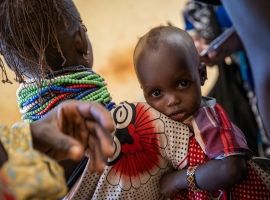
When Lana brought her five-year-old son to the Concern-supported health centre in Baga Sola, a town in the western Lac region, he had already been ill for days. Abdul could not eat.
Without clean water, for both drinking and washing, children fall ill. The spread of waterborne diseases, such as diarrhoea and dysentery, is an aggravating factor in acute malnutrition.
“I came to the health centre because my child is unwell, and I need to get him medicine. He has a stomach-ache, headache, and fever. Every time he eats something, he has diarrhoea. Before, he would play with the other boys but once he got sick, he couldn’t do that anymore. “
“It has really affected me because I don’t have the money to buy the medicine and to take care of him. I have been so scared that he might die.”
Women's work
Before the loss of her husband, Lana’s responsibilities were prescribed by rigid cultural norms: She cooked, cleaned, and cared for the children. He worked, and held responsibility for money, assets, and land. He held all decision-making power. This patriarchal dynamic leaves women like Lana ill-prepared for an ambush of circumstance, for the change of role from housewife to head of household.
Yet still, with children to feed, Lana must go on.
“I do some work, traditional jobs. For example, when someone gets a stomach-ache in our village, I give them traditional medicine, and then I get some money. Sometimes I style women’s hair, and they give me something. Most of the time they pay me with maize and oil, because they too do not have money.”
“Sometimes we eat three times a day, sometimes we eat two times a day. Sometimes our neighbours give us some food when they have a lot.”

Concern and the European Union
Concern, in partnership with the European Union, is supporting health centres in Chad to treat malnutrition in children aged five and under. Concern is improving the standard of care available by training health workers, providing equipment, and ensuring a regular supply of medicine and Ready-to-Eat-Therapeutic-Food (RUTF); a nutrient-rich paste, used to treat malnutrition in children.
In 2024, Concern supported the treatment of over 10,000 Chadian children suffering severe acute malnutrition. The recovery rate for children receiving outpatient nutritional treatment was a remarkable 99%.
The health workers in Baga Sola assessed Abdul using a weighing scale and a MUAC (middle upper arm circumference) band - a simple device for identifying malnutrition in children. Abdul was diagnosed as malnourished. Treatment began immediately.

“He has never been malnourished before. This is the first time. Since we came here and received some medicine and RUTF, he has started to improve slowly. Now I have hope that my son will make a full recovery.”