Read our 2025 annual report

Knowledge Hub


“The symptoms for my daughter were diarrhea, vomiting, coughing, and poor appetite.”
Every parent suffers the fear of watching their child fall ill. But not every parent lives in a displacement camp on the outskirts of Mogadishu, finding a way to survive among the tangle of corrugated iron and tarpaulin shelters.
For Halima, the fear was familiar. She had already lost five children; “They died due to measles, diarrhoea and fever.”
Somalia is in crisis. Another year of drought is forcing rural families to leave their homes and travel to Mogadishu in search of food, water, and basic health care. An estimated 3.5 million people are internally displaced in Somalia.
Halima is one of them. Originally from the Lower Shabelle region, she and her husband were farmers.
“The land was rented. I farmed maize, beans, and sesame. I used to farm for other families, that’s how I made my money. We had six goats, but they died due to drought. We moved because of drought.”
A new life, in displacement
In 2022, Halima and her family travelled eight hours by bus to Mogadishu and started a new life in the displacement camps.
“I was collecting firewood and washing clothes for other households. I would make five dollars a day. Sometimes I would come back empty handed. My husband cared for the children. He became demotivated because he wasn’t making anything at all.”
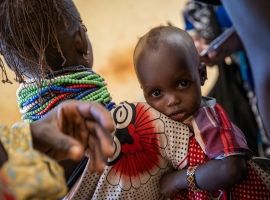
Halima now has five children. The eldest is 13. The youngest, Shukri, is three.
When Shukri fell ill, she was referred to the Banadir Hospital Stabilisation Centre, run by the Ministry of Health and Concern Worldwide, with funding from UNICEF.
In 2026, more than 1.8 million children in Somalia are expected to suffer acute malnutrition. Common diseases, such as diarrhoea, are an aggravating factor: When children are sick, they stop eating.
Concern and the European Union
Shukri was fitted with a feeding tube.
“The first few days, it was horrible, I was constantly worried,” says Halima.
After three days, Shukri started to recover. “She gained weight and was even playing with me.” Halima was fed porridge, rice, and beans every day. Shukri received therapeutic milk. The staff provided guidance to Halima on nutrition and hygiene: “I got advice on how to raise your child with proper meals, how to give the baby a good bath, how to wash their hands properly.”
But for a person living in extreme poverty, knowledge can only take you so far. Halima needed money.
As a member of the Somali Cash Consortium (SCC), funded by the European Union, Concern provides cash to families, with no strings attached. In 2025, the European Union, through Concern and the SCC, sent the equivalent of €10.8 million to over 32,000 Somali households, benefitting nearly 200,000 people.
When a child is hospitalized with malnutrition, the family are provided with cash, to help with life outside the clinic gates, and prevent a relapse.

Within a week of Shukri being admitted to Banadir Hospital, Halima received her first installment of 100 dollars; “Oh God, when I saw the money, I was so happy. I even prayed for the people who gave me that money, you could have felt the joy from my heart.”
The first 100 dollars was spent on food and outstanding bills. The second 100 dollars was spent on buying clothes and more food. “The third installment I paid to my stepmothers,” says Halima. “That month I lost my father. He had other wives. I had to support them.”
Shukri recovered and was discharged; “Now my baby is doing good, she plays a lot with her siblings.”
Life is still hard in the displacement camps, but Shukri is alive, and Halima is thinking of the future.
“I hope that my children go to school and start a farming business.”