


Read our 2025 annual report

Knowledge Hub


In 2026, Concern marks a major anniversary: 30 years of lifesaving work in Sierra Leone.
While you may not see the country in many international headlines these days (it has seen relative peace since the end of a brutal decade-long civil war in 2002), the country still faces significant challenges – especially with regards to hunger, nutrition, poverty, and maternal health.
To better understand where we’ve been and where we’re going, this timeline gives some context to Sierra Leone’s modern history, from its founding by formerly-enslaved people in the late 18th Century to gaining independence from the United Kingdom in the 20th Century, to the last three decades of Concern’s response.
1787-92: The foundation of Freetown
In 1787, 400 formerly-enslaved people (including African-Americans, Afro-Caribbeans, Afro-British, Africans, and Southeast Asians) from London are sent to Freetown as part of a programme established by English philanthropist Jonas Hanway and British abolitionist Granville Sharp.
Five years later, the city of Freetown is formally founded with over 1,100 residents under the guidance of abolitionist John Clarkson.

1808-1961: A colony under the crown
The Freetown settlement becomes a British colony in 1808, with Britain setting up a protectorate over the larger area in 1896. This begins a period of foreign development, with British companies mining iron ore and diamonds starting in 1930.
After World War II, an independence movement gains momentum among the public and in Parliament, which Great Britain eventually grants in 1961 with Milton Margai as prime minister.

1964-68: A shaky transfer of power
Milton Margai dies in 1964 and is succeeded by his half-brother, Albert Margai. In 1967, Siaka Stevens is elected prime minister but faces political opposition, including a coup in the same year and (after he returns to power in 1968) another failed coup and several assassination attempts.
1971-78: The beginnings of unrest
Sierra Leone is declared a republic in 1971, with Stevens as its first president. In 1978, a new constitution proclaims the country a one-party state. This sets off a period of leadership marked by civil unrest, food shortages, and economic crises.

1985: Transfer of power
Stevens retires in 1985 and Major-General Joseph Saidu Momoh becomes president.
1987: A growing epidemic
The first cases of HIV/AIDS are documented in Sierra Leone.

1991-92: The beginnings of civil war
Mounting civil unrest and opposition under Mohmoh leads to civil war, which begins in March 1991 when roughly 100 fighters under former army sergeant Foday Sankoh begin taking control of towns along the border between Sierra Leone and Liberia.
Six months later, Sierra Leone adopts a new constitution allowing for a multiparty system. In April 1992, Momoh is ousted in a military coup by Valentine Strasser.
The growing conflict will also lead to a steady rise in HIV/AIDS prevalence across the country, which peaks at 14.9% over the next decade of conflict.


1996-99: A deepening crisis
As the war continues (with boys as young as 12 years old enlisting to fight), Valentine Strasser is ousted in a coup. Ahmad Tejan Kabbah is elected president the following month and signs a peace accord in November. The peace deal unravels in 1997, leading to Kabbah being deposed by the army that May.
Concern begins working in Sierra Leone in 1996, responding to the growing humanitarian needs driven by conflict and displacement.
Nigerian-led peacekeepers return Kabbah to power in 1998. Opposition forces attack Freetown. Peackeeping forces retake the capital after several, leaving 5,000 people dead and the city devastated by fighting. Thousands more people are captured and subjected to abuse and forced conscription.

1999-2000: UN Intervention and a fragile peace
A ceasefire in May, 1999 leads to six weeks of peace talks in Togo’s capital of Lome. The Lome Peace Accord is signed in July, and UN troops arrive at the end of the year to monitor the peace agreement. The UN troops become targets of non-government forces, with hundreds of soldiers abducted throughout 2000 and Freetown once again coming under attack.

2001-02: An eventual peace
UN forces deploy peacefully in areas held by non-government forces and begin to work towards disarmament. The war is officially declared over in January 2002 when the UN announces 45,000 fighters have been disarmed. Kabbah is reelected as president that May.
Concern’s emergency response teams begin to focus on recovery, providing emergency shelter for returning refugees and basic healthcare focusing on civilians who lost limbs during the war. We also begin to work with families whose livelihoods depend on agriculture to rehabilitate damaged farm lands and increase crop production. In the first year of peace, we help to improve the living conditions of 25,000 people. We also support over 7,500 refugees fleeing civil war in neighbouring Liberia, which will continue through 2003.


2004-07: From emergency response to sustainable livelihoods
UN Peacekeeping forces wind down their presence, and free elections for local representatives are held for the first time in 30 years, leading to the creation of local district councils. However, civilians continue to face high inflation and unemployment, as well as regional instability.
Concern’s work transitions from emergency interventions to sustainable development, focusing on four key pillars: livelihoods security, basic primary education, community health, and HIV and AIDS response.
Five years after the end of the war, the overall situation continues to improve with the first national elections since the departure of UN peacekeeping forces held in 2006. Nonetheless, challenges remain with over 70% of the population living below the poverty line.
 David Beckham in Sierra Leone with UNICEF and Concern Worldwide
2009-16: Innovations for mothers and newborns
Through the ’90s and ’00s, Sierra Leone consistently ranks among the most dangerous countries to become a mother.
With funding from the Bill & Melinda Gates Foundation, Concern launches Innovations for Maternal, Newborn, and Child Health, a programme designed to use design thinking to address challenges to maternal and child health in several countries.
In Sierra Leone, Innovations supports three locally-designed projects:
- Helping Health Workers Cope: A programme delivering psychosocial support to health workers through both individual and group sessions.
- Essential Newborn Care Corps: Trained traditional birth attendants in modern antenatal and delivery care to reduce maternal mortality rates while supporting this group of traditional workers.
- Quality Circles: Peer learning and support groups for traditional birth attendants and modern healthcare workers.
We also adapt our Innovations programmes to address the needs driven by the West African Ebola outbreak.

2011: A landmark for AIDS/HIV care
Concern helps to campaign successfully for a change to Sierra Leone’s 2007 HIV and AIDS Prevention and Control Act, addressing emerging issues relating to stigma and discrimination.
2011-2017: Al Pikin fo Liv
In 2011, we also launch Al Pikin fo Liv (“Every Child Must Live”) across 10 informal settlements in Freetown, a programme designed to reduce maternal, infant, and child mortality rates through community health action and systems strengthening.
In the three years that community health workers make calls and lead community activities during this programme, they help to lower mortality rates for over 36,000 women and 35,000 children under the age of five. By the end of 2017, countrywide mortality rates for children drop by more than 4 percentage points (16% to under 12%).


2012: The largest cholera outbreak on record
Sierra Leone is hit by its largest cholera outbreak on record, spreading to 12 out of the country’s 13 districts. Concern responds quickly, reaching over 250,000 people with emergency kits, hygiene promotion, and clean water sources, successfully reducing the number of cases.
2014-16: The world’s largest Ebola outbreak
In March 2014, a case of Ebola is confirmed in the West African country of Guinea. The disease soon spreads throughout the region, including Sierra Leone. The outbreak soon becomes an epidemic, the largest on record for the Ebola virus.
Concern responds to this global health emergency in both Sierra Leone and Liberia. We develop systems of safe and dignified burials to curb the spread while giving communities the chance to grieve their loved ones. We support local health centres with staff, training, equipment, and other resources, and launch a major awareness and prevention campaign to fight off harmful myths about the virus.


In Freetown, we also support the Ebola Command Centre, receiving calls about new cases and deaths and dispatching ambulances and burial teams. We also work with the Ministry of Education to deliver distance learning to students, enabling them to keep up with their education while sheltering in place via radio lessons.
By the time the epidemic is declared over in June 2016, we help Sierra Leoneans bury over 17,000 loved ones – and save the lives of many more through prevention and treatment. Nine of our burial team members receive awards from the President of Sierra Leone for their dedication.
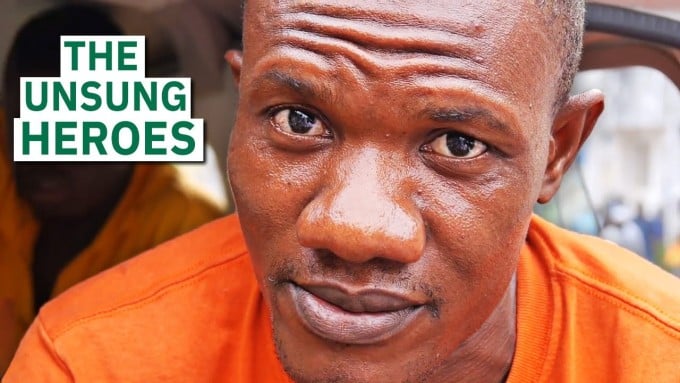 The history of the Ebola health crisis and the unsung heroes of Ebola
2017-21: Safe learning for all
After the success of our distance-learning response to the Ebola epidemic, Concern launches the Safe Learning Model, a programme that takes a holistic approach to education, based on evidence that children’s educational progress is improved when they live in communities that are underpinned by support for equality and children’s wellbeing.
Safe Learning Model addresses access to education, quality of education, and child wellbeing by reducing school-related gender-based violence and other harmful norms that keep children out of the classroom. The programme is especially successful for girls’ education and literacy.

2017-Present: Saving lives together
Concern also launches a major project in 2017, Saving Lives in Sierra Leone. A multi-phased health-systems strengthening programme, Saving Lives addresses the interconnected causes of healthcare challenges in the country, including a lack of: blood donations, protection and safeguarding, health rights and literacy, nutrition and dietary diversity, disability inclusion, operational support, and strong management and leadership.
Saving Lives addresses these challenges through initiatives including mentorship programmes, last-mile distribution for vaccines and other supplies, community awareness sessions, small-but-mighty health innovations (like CRADLE), and maternal mortality prevention protocols.
Phase III of Saving Lives launches in 2023, and will continue into 2028 – marking more than a decade of this programme, run by a consortium of six NGOs led by Concern. In that time, Saving Lives will reach more than 2.2 million people, including women of reproductive age, adolescent girls, and children under the age of five.


2019-22: Landmarks for Sierra Leonean women
The Sierra Leonean government launches the Business Incubator for African Women Entrepreneurship, with an emphasis on supporting women in agribusiness. In the same year, the government also establishes a Women’s Development Fund to provide seed capital to female entrepreneurs. These actions help to support women’s rights (especially rural women), while also addressing some of the ongoing maintainers of poverty in the country.
Another landmark change comes in 2022, with the adoption of the Customary Land Rights Act. This grants women equal rights to own, inherit, and use land – an essential right for the millions of women farmers in the country.


2023-Present: Stronger food systems and a small milestone
To address the chronic hunger issues faced by Sierra Leoneans, Concern launches Yoti Yoti, a €6 million five-year project funded by Irish Aid designed to strengthen food systems in 108 communities across the Tonkolili and Port Loko districts.
The programme pilots solar-powered irrigation in two communities, trains lead farmers in Farmer Field Schools, and supports the Ministry of Agriculture and Food Security in immunising farm animals.
In 2024, we exceed our targets for the number of different types of produce grown by participating farmers, increasing from 2.8 at baseline to 4.76 in year two (with a goal for that year of 3.36). In 2025, Sierra Leone hits another milestone: For the first time in years, it does not fall among the 10 ‘hungriest’ countries as ranked by the Global Hunger Index.

Help us make poverty a thing of the past in Sierra Leone – and around the world


