


Read our 2025 annual report

Knowledge Hub


Every August 19, we honour the aid workers risking everything on the frontlines.
Celebrated annually on August 19, World Humanitarian Day is an international day that honours humanitarian workers, particularly those who have died in the line of duty.
It first began in 2008, to mark the anniversary of the 2003 Canal Hotel bombing in Baghdad, which killed 22 humanitarian workers. Since then, August 19 has served as a global call for solidarity, remembering those we’ve lost while recommitting to the vital work ahead.
Here’s what you need to know about World Humanitarian Day 2026, including this year’s theme, the Concern workers we’ve lost, and our ongoing commitment to our global team of humanitarians.
What is the theme for World Humanitarian Day 2026?
This year’s theme is “Families of Fallen Humanitarians,” highlighting the personal stories of aid workers through the voices of families, loved ones, and the communities they left behind.
This is at the heart of all World Humanitarian Days, but it’s especially critical in 2026: Last year was one of the deadliest on record for humanitarians, with 907 killed, injured, or kidnapped, according to the UN’s Office for the Coordination of Humanitarian Affairs (OCHA). Of this number, 350 were killed – 186 in Gaza alone. So far this year, 82 humanitarian aid workers have been killed, 97 have been injured, and 39 kidnapped. As OCHA Under-Secretary-General Tom Fletcher said earlier this week:
More than 1,000 aid workers have been killed in just three years, and that is utterly unacceptable. But just calling it out will not protect the next aid worker. States must uphold international humanitarian law and use every tool to protect civilians and our colleagues. And for those who break the rules, there must be real consequences.
Why do we celebrate World Humanitarian Day?
Aid workers are an integral part of the recovery process for humanitarian crises both large and small, especially in countries and communities with few resources to cope with these types of shocks.
World Humanitarian Day acknowledges the bravery, commitment, and contributions these professionals have made, particularly those who have made the ultimate sacrifice.
“Ultimately, the lynchpin of our security is acceptance, so the people on the ground – that is, local communities, other agencies, government personnel, and all parties to conflict – know who we are and recognise the benefits that our presence brings,” Concern’s Humanitarian Ambassador Dominic MacSorley wrote in 2017.
This is the most effective way of minimising any risks to staff. However, it is not always enough.
We need more than acknowledgement; we need action.


The human cost of humanitarian work
Our dedication to humanitarian principles and action has been exemplified by Valerie Place. A nurse from Dublin, Valerie joined Concern Somalia in response to the 1992 famine. She managed a feeding centre in Mogadishu, which saved the lives of thousands of children.
Valerie was traveling in a humanitarian convoy back to the city on February 22, 1993 when the convoy was attacked. She became the second western aid worker to be killed in Somalia during the famine. She was 23.
In 2016, Concern’s Dr. Du’ale Mohammed Adam was also killed in Somalia, when a bomb exploded outside of the hotel he had parked in front of. At the time, he was working with Concern to scale up operations amid a growing drought in the country, which was threatening to create another famine. Dr. Adam was 33, and left behind a wife and five children.

Why supporting humanitarian families matters
World Humanitarian Day isn’t just about the humanitarians we have lost. It’s also about the families and loved ones they leave behind. For Concern, the profound grace of those families is a deeply personal part of our history.
Concern board member and former volunteer nurse Frances O’Keeffe describes exactly this grace in Deirdre Purcell’s 2015 biography of Aengus Finucane, who was with Valerie when she was killed. O’Keeffe traveled with Valerie’s father and sister to collect her body in Germany. On the flight, Paddy Place turned to O’Keeffe:
“I’m just wondering, Frances, is Concern going to leave Somalia?”
When O’Keeffe said they hadn’t even considered it, Paddy was relieved. “I hope they don’t, because poor Valerie would have died in vain.”
O’Keeffe’s conversation with Place captures the core of humanitarian commitment. It’s a reminder that the decision to stay and work in the world’s most challenging environments isn’t driven by heroics, but rather by a fundamental solidarity with the communities in crisis.
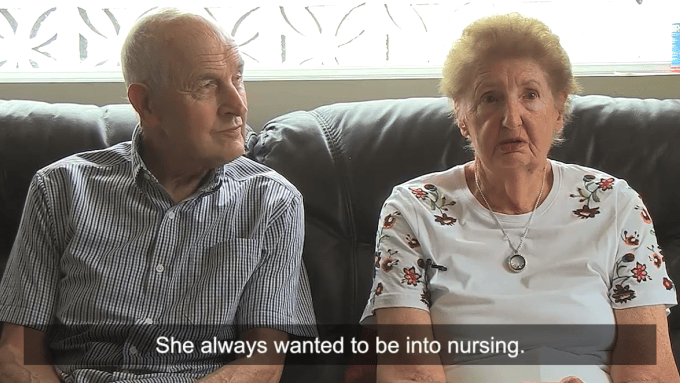
 Valerie Place’s parents reflect, 25 years on (2018)
But that solidarity must also extend to the families who bear the ultimate cost. Supporting the loved ones left behind, long after the headlines fade, is a vital part of our responsibility.
“Concern always keeps in touch with us,” Valerie’s mother, Peggy, said in 2018. “It happened such a long time ago, you’d think a lot of people would have forgotten.”
How does Concern prioritise the safety of its teams?
“If we wanted to be safe, we would not work where we are working. Insecurity is a consequence of the contexts within which we work,” says Concern CEO Dominic Crowley.
But the call to help people in vulnerable situations is too great for our teams to ignore. Concern therefore places the safety and security of its staff among our highest priorities. We invest heavily in comprehensive security training and update plans for each country where we operate. Country teams are frequently in contact with national staff as well as with our main office in Dublin. MacSorley adds:
We do not control the situations in which we operate, but we do control who we put into these environments and how we equip them with knowledge and training to work securely.
At times, this also means suspending work when necessary, such as when conflict in Sudan escalated in April 2023. Concern had 140 Sudanese staff in the country, all of whom were forced to shelter at home or in displacement. Concern was thankfully able to resume work within a matter of weeks thanks to the dedication of its staff.
That dedication is at the heart of every humanitarian. After a 2017 bomb was detonated in Kabul, Afghanistan, our country director at the time recalled the morning after: “I woke up and thought, We are here to support the people of Afghanistan, and got back to work.”

How can I support humanitarian workers?
The challenges facing humanitarians and local communities in 2026 are immense, but every action helps to build solidarity and resilience:
Stand with frontline workers: Follow and share stories from Concern’s emergency response work, responding to complex crises worldwide.
Champion humanitarian leadership: With Ireland holding the EU Presidency, we have a unique opportunity to shape global policy. Discover how our partnership with Irish Aid advocates for humanitarian principles, aid worker protection, and community-led response at the highest levels of European decision-making.
Fuel emergency response: Support Concern’s work so our teams can respond rapidly and safely when disaster strikes.


